Temperature Modifying Induction Curing Additives
KEY INFORMATION
Chemicals - Coatings & Paints
TECHNOLOGY OVERVIEW
Manufacturing with plastics, particularly thermoset and thermoplastic resins, has long been constrained by inefficient and energy-intensive heating methods. Current practices rely on large ovens, autoclaves, or surface heating techniques using gas or electric conduction. These approaches not only consume significant energy but also require prolonged processing times and manual interventions, limiting scalability and automation. As industries look for smarter, more efficient temperature control technology, the limitations of traditional processes have become even more pronounced.
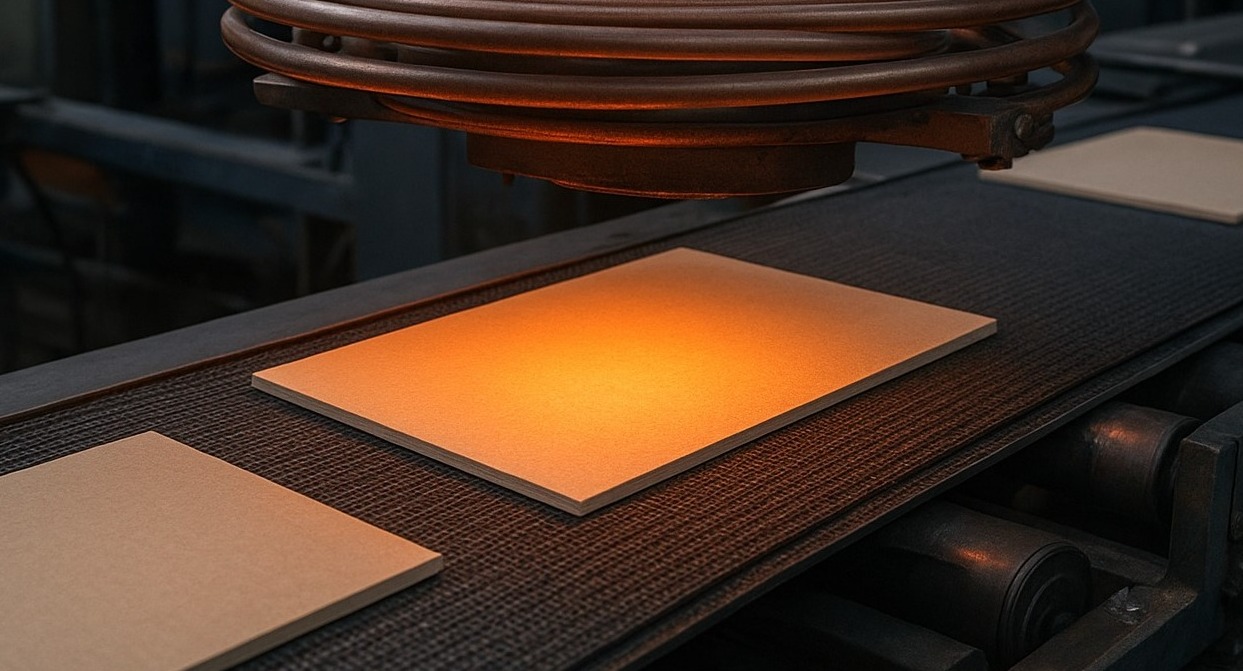
This technology bridges induction heating into plastics for the first time, supporting precise heat control comparable to advanced temperature control technology systems. This creates opportunities for automated, energy-efficient manufacturing of thermoset (epoxy/urethane) or thermoplastic resins not possible through other surface heating methods. This disruptive manufacturing technology allows volumetric heating of plastic parts required in automotive, sports, and green energy sectors. Non-contact, volumetric heating occurs through incorporation of specially designed ceramic particle additives, enabling induction curing behaviours within the part. The additives convert magnetic fields to heat for activation of adhesives, coatings, or melting of thermoplastics, providing pathways for future automated induction curing and bonding workflows. This technology replaces inefficient fabrication methods such as energy-intensive ovens, autoclaves, and surface gas/electric conduction-based heating. Induction provides remote activation, real-time feedback, and external digital manipulation for a new paradigm of assembly design intents. This innovative transformation removes laborious manufacturing methods and aligns with current goals of energy efficiency and long-term sustainability.
The technology owner is actively seeking R&D collaborations, licensing partnerships, and IP acquisition opportunities with manufacturing companies in adhesives, sporting goods, and automotive manufacturing.
TECHNOLOGY FEATURES & SPECIFICATIONS
- Induction technology for plastic manufacturing allows instantaneous heating.
- Additive technology exploits particles that convert magnetic fields to heat.
- Impart remote, on-demand activation of adhesives through other materials.
- Integrates with automated assisted manufacturing, in-line productions.
- Provides real-time processing feedback, with a 50 - 300°C temperature range.
- Heating gradients of 0.1 - 2°C per second gradients achievable.
- Technology can be used for both bonding and later debonding.
- Applicable to plastics, adhesives, coatings, rubbers.
- Additive technology, no re-formulation required for proprietary resins.
- Ceramic additives, chemically inert, stable to 600ºC.
POTENTIAL APPLICATIONS
- Shoes & Foams: Precise activation of adhesive films as specific stations
- Paints & Coatings: Non-contact curing/drying of resins 0.1 – 5 mm thick.
- Composites & Laminates: Instantaneous curing/melting of parts 1 – 50 mm deep.
- Complex Assembly: Bonding of internal substrates after assembly.
- New Process: Design and separation of independent fabrication procedures.
Unique Value Proposition
- Energy efficient technology can reduce kwh usage by 5 – 10-fold.
- Target resin/material temperatures are set in seconds to minutes.
- Reduces manufacturing labour, fabrication time & energy.
- Allows through space heating of plastics/resins with no line-of-site required.
- Additives/magnetic field exposure poses no danger to human health.

Enhanced Antimicrobial Properties of Polymer Products with Silver Nanoparticles
Multifunctional Multilayer Coating for Building and Photovoltaic (PV) Application
Plant-based Additive for Bioplastic Barrier Enhancement
Functional Paint Additive to Prolong Solar Reflectance of Cooling Paint
Solution to Repair Concrete Cracks, Mitigate Rebar Corrosion and Concrete Carbonation
Hybrid Photocatalytic Film with Enhanced Antibacterial and Antiviral Properties
Cost-Effective Spray Coating for Passive Radiative Cooling in Buildings
Green and Multifunctional Graphene-based Antibacterial Composite for Textiles
Toothpaste Formula for Reducing Tooth Sensitivity